Week of April 5-11, 2026
Geometric patterns are fun to trace among the stars. In past articles, I've told you about the Summer Triangle, the Winter Hexagon (or Oval), and autumn's Great Square of Pegasus. Today, I'd like to suggest you step outside one night during April to seek out what we in the Northern Hemisphere might call the Spring Triangle.
This star grouping is pretty easy to find, once you spot the Big Dipper, now standing midway up in the northeastern sky after dark.
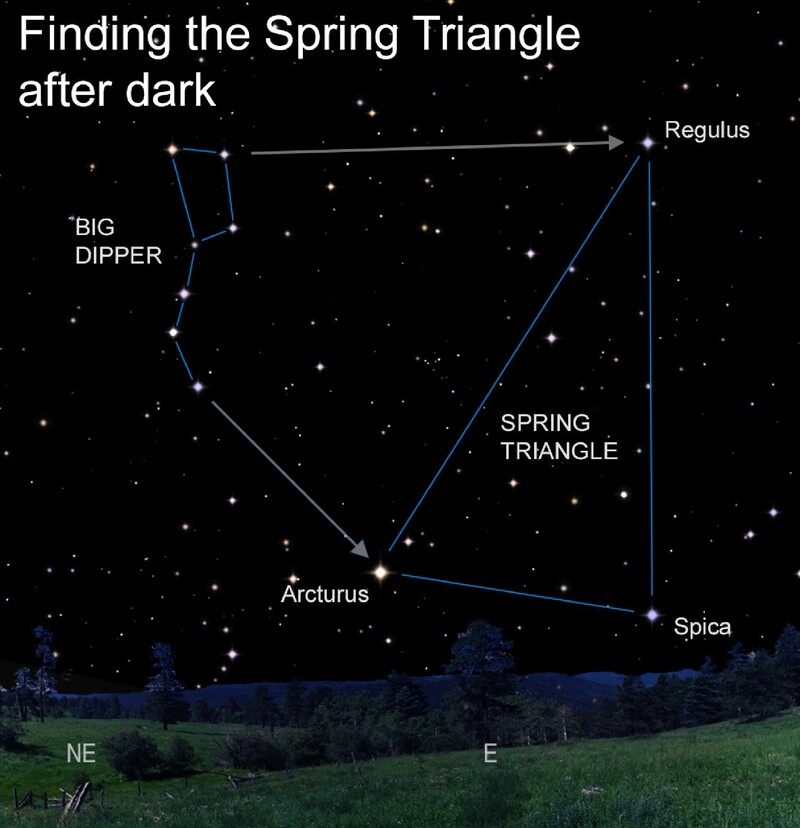
First, use the handle of the Dipper to find the star Arcturus. Simply follow the curve of the handle away from the bowl until you encounter this yellow-orange star low in the east. Then, continue that line onward toward bluish-white Spica, a bit lower in the eastern sky.
The third star of the triangle is much higher in the east. Its name is Regulus, and we can use the Big Dipper's bowl to find it. Locate the two stars in the bowl farthest from the handle. These, you may recall, are known as the pointer stars, because if we follow them from the bowl's bottom to its top, and extend that line five times farther, we'll find Polaris, the north star.
To locate Regulus, however, we will need to follow these stars in the opposite direction, from the top of the bowl to the bottom, and continue that line on until you encounter this bright star.
The Spring Triangle, much like every other geometrical pattern we recognize in the sky, is not a constellation. A constellation is one of 88 officially designated areas of the heavens that represent objects, animals or people but do not necessarily resemble any of them. The three stars of the Spring Triangle, however, are each the brightest of three separate constellations, and together they form an "asterism," a group of stars that actually looks like something.
Arcturus belongs to Bootes, the herdsman, Spica marks a shaft of wheat in the hand of Virgo, the maiden, and Regulus forms the heart of Leo, the lion (and the bottom of a backward question mark of stars that outlines the lion's head).
These three stars are also quite different from one another.
Arcturus is a red giant star located nearly 37 lightyears from us. It's a huge star about 25 times larger, and some 170 times more brilliant, than our sun, and its orange color is pretty obvious.
Spica, on the other hand, is a blue giant star that lies about 250 lightyears from Earth. It's part of a binary system — two stars that revolve around each other so closely that their mutual gravitational pull distorts each into an egg shape!
The third star, Regulus, is what astronomers know as a blue straggler — a star that's hotter, brighter and bluer than one would expect for a star of its type. At a distance of about 79 lightyears, it, too, is not a single star but is part of a quadruple system composed of two stellar pairs that orbit one another.
Be sure to check out these three stars of the Spring Triangle on your next clear night!
Visit Dennis Mammana at dennismammana.com. To read features by other Creators Syndicate writers and cartoonists, visit the Creators Syndicate website at www.creators.com.
Once you locate the Big Dipper in the sky, the Spring Triangle is easy to find.







View Comments